Luxors West Bank: Complete Guide to the Valley of the Kings, Medinet Habu & Theban Necropolis
Across the Nile River from the bustling modern city of Luxor lies a landscape of dramatic dualities that shaped the beliefs and lives of the ancient Egyptians . The West Bank presents a stark transition from a verdant, life-giving floodplain, created by millennia of the Nile's annual deposit of fertile silt, to a sterile, mountainous desert of limestone cliffs and arid wadis known as the Theban Hills . This geographical contrast was mirrored in the ancient Egyptian worldview . The East Bank, where the sun rose, was the vibrant heart of the living city, home to the great temples of Karnak and Luxor . The West Bank, where the sun set each evening, was the domain of the dead .
This belief transformed the West Bank into a sprawling "City of the Dead," a sacred ground where the deceased were believed to begin their journey into the afterlife . The very geology of the area, with its layers of hard Thebes Limestone and softer Tarawan Chalk, was ideal for carving the eternal homes of pharaohs, queens, nobles, and the artisans who built their tombs . Today, this area is not only a treasure trove of archaeological wonders but also a vibrant center of ongoing exploration and a living community grappling with the complex legacy of its past .
Major Funerary Temples: Houses of a Million Years
Mortuary temples were not tombs but grand places of worship dedicated to the cult of the deceased pharaoh, ensuring their legacy and divine status would endure for eternity . Built on the desert plain at the foot of the Theban cliffs, they formed a dramatic and imposing backdrop, mediating between the land of the living and the necropolis of the dead . These monumental structures continue to be sites of major restoration and study .
Medinet Habu: The Fortress Temple of Ramesses III
The Mortuary Temple of Ramesses III, known as Medinet Habu, is one of the largest and best-preserved temple complexes on the West Bank . Its name means "City of Habu," a reference to a local form of the god Amun . Built during the 20th Dynasty, it served as a temple, administrative center, and a fortified royal palace, protected by a massive mudbrick enclosure wall .
Architecture and History: The temple is renowned for its imposing Syrian-style gate and towering pylons decorated with vivid reliefs . The exceptional preservation of the temple means that many of its reliefs and columns still retain their vibrant original colors . During times of instability, the fortified walls of Medinet Habu provided refuge for the local population, and the complex later became a walled town for Coptic Christians .
The 'Sea Peoples' Reliefs: A Record of CollapseThe northern outer wall of Medinet Habu provides the most extensive ancient record of the "Sea Peoples," a coalition of invaders who threatened Egypt during the Late Bronze Age collapse . The reliefs depict Ramesses III's victory in land and sea battles around his eighth regnal year (c. 1177 BCE) .
- Ethnic Groups and Weaponry: The artists meticulously differentiated the various groups . The Peleset and Tjeker (often identified with the later Philistines) are shown with distinctive "feathered helmets," armed with long straight swords, spears, and round shields . The Sherden, who had previously served as mercenaries for Egypt, are identifiable by their horned helmets . In the land battle, the invaders use three-man chariots, unlike the typical two-man Egyptian chariots .
- Naval Warfare: The sea battle is a chaotic tangle of ships . The Sea Peoples' vessels are shown with high, bird-headed prows and sterns, using sails but apparently lacking oars . Egyptian ships, equipped with both oars and sails, had greater maneuverability in the Nile Delta, where Ramesses III trapped the invading fleet . The reliefs show Egyptian sailors using grappling hooks to capsize enemy ships and archers firing from crow's nests, a new technology at the time .
- Historical Significance: The reliefs depict not just warriors but also families with women and children in ox-carts, suggesting a mass migration rather than a simple military raid . While once seen as the primary cause of the Late Bronze Age collapse, modern scholarship now views the Sea Peoples as both a cause and a consequence of a wider "systems collapse" triggered by factors like drought, famine, and political instability . Ramesses III's victory, immortalized at Medinet Habu, is seen as the moment Egypt stood firm against the storm that brought down other great empires .
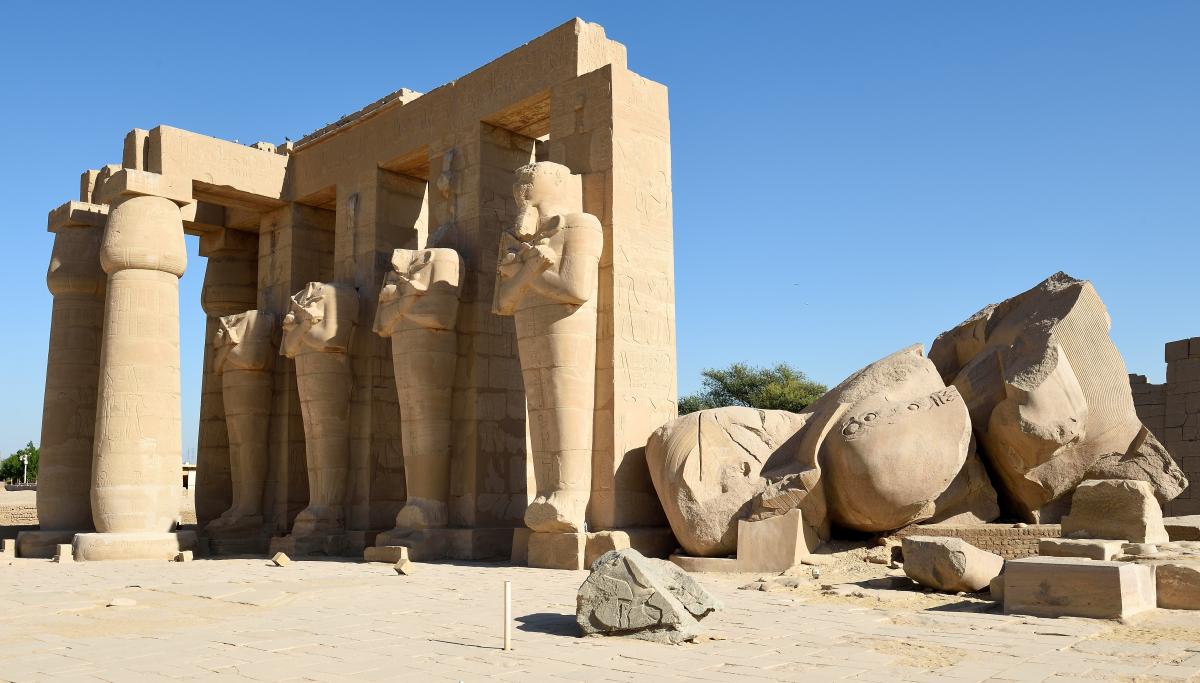
The Ramesseum: Ozymandias' Legacy
The Ramesseum is the memorial temple of Pharaoh Ramesses II, built in the 13th century BCE as a "House of millions of years" . Though now in ruins, its scale is immense .
- The Fallen Colossus: The temple is famous for the shattered, 1,000-ton colossus of Ramesses II that inspired Percy Bysshe Shelley's poem "Ozymandias" .
- Architectural Grandeur: The complex included massive pylons and a vast 48-column hypostyle hall, with walls decorated with scenes from the Battle of Kadesh .
Mortuary Temple of Seti I at Qurna
Located near the modern village of Qurna, this temple was constructed by Seti I and completed by his son, Ramesses II, to honor Seti's deified father, Ramesses I .
- Artistic Excellence: The temple is celebrated for its delicate and masterfully executed reliefs, considered a pinnacle of New Kingdom art .
- Current State and Research: Much of the temple's forecourts and pylons are now in ruins or buried under the modern town . The German Archaeological Institute (DAI) has been involved with the site since 1972 . While major new excavations are not currently underway, the DAI's project focuses on processing and publishing data from extensive work conducted between 1969 and 2001, alongside ongoing conservation of the exquisite reliefs in the surviving hypostyle hall and chapels .
Valleys of the Nobles and Artisans: A Sacred and Strategic Choice
Beyond the royal burial grounds, other valleys reveal the lives of the people who served the pharaohs and built their eternal homes . The unique topography of the West Bank was not only religiously symbolic but also highly practical for the creation of the necropolis . The secluded dry riverbeds, or wadis, offered a measure of security from tomb robbers, while the natural pyramid-shaped peak of El Qurn, "The Horn," which presides over the valleys, is thought to have echoed the Old Kingdom pyramids and symbolized the primeval mound of creation .
Tombs of the Nobles
Nestled in the foothills are over 450 tombs belonging to the high-ranking officials of ancient Thebes . Unlike royal tombs, they are adorned with vibrant scenes of daily life, providing an invaluable look at ancient Egyptian society .
- Geological Choice: These tombs were often hewn into the hillsides of areas like Sheikh Abd el-Qurna, utilizing the slightly softer but still suitable Tarawan Chalk layer of the Theban Hills, a deliberate choice by ancient architects who adapted their designs to the specific geology .
- Ongoing Research and Recent Discoveries: This area is bustling with international and Egyptian missions.
- Egyptian Discoveries: In May 2025, an all-Egyptian mission discovered three New Kingdom tombs in the Dra Abu el-Naga area belonging to high officials, including a supervisor of the Temple of Amun and a mayor of the northern oases . This find is celebrated as a testament to the growing expertise of national teams .
- South Asasif Conservation Project: In November 2024, a joint Egyptian-American team discovered a 4,000-year-old Middle Kingdom family tomb with 11 sealed burials . This was the first of its period found in the South Asasif necropolis and yielded exquisite jewelry, changing the understanding of the area's history .
- The Djehuty Project: A Spanish mission working since 2002 has made significant finds, including a rare 4,000-year-old small-scale funerary garden in front of a Middle Kingdom tomb, shedding new light on ritual practices .
- Other Missions: Numerous other teams are active, including a Hungarian mission at el-Khokha and a Polish expedition in North Asasif, highlighting the global effort to uncover Thebes' secrets .
Deir el-Medina: The Village of the Tomb Builders
Known as Set Maat ("The Place of Truth"), Deir el-Medina was the village that housed the skilled artisans who constructed the royal tombs in the Valley of the Kings . They were salaried state employees, and the site provides a rare, detailed look into the lives of ordinary Egyptians . The village was strategically situated on higher ground at the edge of the desert to avoid the annual Nile flood .
- Ongoing Research:
- French Institute of Oriental Archaeology (IFAO): The IFAO has held the concession since 1917 and resumed excavations in 2012 . A recent collaboration with the Museo Egizio of Turin focused on conservation in the tomb of Khaui (TT214) .
- The Bioarchaeology of Deir el-Medina Research Project: This American-led project is conducting the first comprehensive study of human remains from the village . The 2024 season completed analysis of three tombs, providing a direct look at the health, diet, and occupational stress of the earliest villagers . Findings have corroborated texts about healthcare, including evidence of a man with a congenital disability who was cared for by the community .
Other Notable Sites
The Temple and Palace Complex of Amenhotep III
Pharaoh Amenhotep III presided over an era of immense wealth and artistic flourishing, leaving behind a monumental architectural legacy . While the West Bank was primarily a necropolis, large palace complexes and administrative centers show it also supported a significant living population connected to royal and funerary projects .
Colossi of Memnon and the Vanished Temple: These two massive stone statues of Amenhotep III are often the first monuments visitors see on the West Bank . They once guarded the entrance to his mortuary temple, which was the largest in Egypt before being destroyed by earthquakes and its proximity to the Nile's annual flood . The northern statue was famous in antiquity for "singing" at dawn after being damaged in an earthquake .
The Amenhotep III Temple Conservation Project: Since 1998, this Egyptian-German mission, led by Dr. Hourig Sourouzian, has been working to excavate and restore the temple's scattered remains . The goal is to create a vast open-air museum .
- Recent Discoveries: The project has unearthed and re-erected numerous colossal statues of the king . A major 2022 find was two colossal sphinxes of Amenhotep III, each about 8 meters long . Dozens of statues of the goddess Sekhmet have also been recovered, and excavations have revealed the temple was even larger than previously thought .
Malkata Palace: To the south lie the mud-brick ruins of Amenhotep III's main residence, known as "the Palace of the Dazzling Aten" . This royal city, along with the recently discovered "lost golden city" of Aten, offers a rare glimpse into the opulent daily life of a pharaoh and the administrative centers that supported the necropolis .
Howard Carter's House
This modest mud-brick house near the Valley of the Kings was the home and workspace of archaeologist Howard Carter during his search for Tutankhamun's tomb . Now a museum, it contains his personal belongings and a replica of the tomb's burial chamber, offering a window into one of archaeology's greatest discoveries .
Modern Life on the West Bank: A Living Heritage
The West Bank is not just an open-air museum; it is a living community where daily life unfolds amidst monumental history . The villages of Gurna and Al-Bairat present a vibrant tableau of contemporary Egyptian life, deeply intertwined with the Nile, the past, and tourism .
Daily Life and Community
Life here offers a stark contrast to the urban energy of the East Bank, with many locals calling it the "real Egyptian side" .
- Al-Bairat: This village is characterized by a serene, rural atmosphere, with life moving at a tranquil pace amidst green fields and traditional houses .
- Gurna (Qurna): A History of Displacement: The story of the Gurna community is a painful and complex saga of displacement in the name of heritage protection . For centuries, the Qurnawi people lived in a village that grew organically over and within the Tombs of the Nobles . By the early 20th century, the Egyptian government sought to relocate the community for several reasons: to halt the illicit trade of antiquities, a practice some villagers were involved in and which had been noted by European travelers since the 18th century; to clear the area for systematic archaeological work; and to "sanitize" the landscape for the growing tourism industry .
- Hassan Fathy's Vision: In 1945, the government commissioned architect Hassan Fathy to design "New Gourna" . His vision, detailed in his book Architecture for the Poor, was revolutionary . He rejected concrete and steel, instead championing traditional mud-brick (adobe) for its low cost and superior passive cooling properties . He revived the ancient Nubian vaulting technique to create domes and vaults without expensive timber . His master plan was for an integrated community with a mosque, school, theater, and market, designed to preserve the social structures of the five tribes of Old Qurna .
- Resistance and Failure: The project was never fully realized and was met with significant resistance . Many villagers' livelihoods were tied to the necropolis through tourism and excavation work, and the new village was seen as a threat to their income . Culturally, many associated mud-brick with poverty and aspired to modern concrete homes, which they saw as a symbol of progress . Some were also reluctant to live under the domed roofs, which they associated with tombs and mosques . The project was ultimately a top-down government initiative that failed to achieve genuine community participation, and it faltered due to wavering government support and funding .
- Long-Term Consequences: The protracted relocation process, culminating in a final, forceful eviction between 2006 and 2009, shattered the once close-knit Qurnawi community . Families were scattered across new settlements, destroying social support networks and creating a profound sense of injustice . Many complained that the later government-built housing was small, poorly constructed, and lacked crucial space for their livestock .
The Local Economy: Agriculture, Crafts, and Tourism
The economy is a blend of traditional practices and a heavy dependence on tourism .
- Agriculture: The fertile lands along the Nile have sustained life here for millennia . For thousands of years, farming was defined by the Nile's annual inundation, which deposited a fresh layer of nutrient-rich silt . A significant expansion of this floodplain around 4,000 years ago was crucial to the agricultural success of ancient Thebes . Ancient farmers used basin irrigation to grow staples like emmer wheat and barley . While the Aswan High Dam ended the natural flood, the tradition continues with crops like sugarcane, wheat, and mangoes, still reliant on the Nile's waters .
- Local Crafts: The area is renowned for its skilled artisans . The Gurna area has over 100 alabaster workshops, a trade passed down through generations . In Al-Bairat, cooperatives like "Habiba Hand Weaving" keep the art of traditional weaving alive, providing vital employment, particularly for women .
- The Influence of Tourism: Tourism is the dominant economic force, with an estimated 95-97% of the population working in related fields . This reliance makes the economy vulnerable to global events and has created tensions over development and the distribution of economic benefits .
Current Management and Future Development
In recent years, the Egyptian government, guided by its "Egypt Vision 2030" sustainable development strategy, has embarked on a new phase of managing the West Bank . This involves a delicate balancing act between preservation, development, and community well-being .
- Government Strategy: The government is working with UNESCO to create a comprehensive Integrated Management Plan for the Theban Necropolis . This is happening alongside massive development projects like the reopening of the Avenue of Sphinxes and the development of the Nile Corniche . A 2023/2024 investment plan allocated 7.7 billion EGP for 201 development projects in the Luxor Governorate .
- International Collaboration: This new approach relies heavily on international partners.
- UNESCO provides continuous monitoring and has funded projects to safeguard Hassan Fathy's village and build local capacity .
- USAID has invested over $100 million since the 1990s in conservation, tourism development, and community empowerment projects in the Luxor area .
- The Factum Foundation, through the Theban Necropolis Preservation Initiative, uses advanced 3D scanning to create digital records of tombs for conservation, while also training local community members in these new technologies .
- Enduring Challenges: Significant challenges remain. The sheer volume of tourists and the effects of climate change pose a threat to the fragile monuments . There is also a risk that the economic benefits of large-scale tourism projects will not reach the local population, whose relationship with the past is often defined by the painful legacy of displacement . However, initiatives that focus on community involvement, eco-tourism, and local training represent a growing recognition that a sustainable future for the West Bank must include its people .
Executive Summary
The West Bank of Luxor, the ancient necropolis of Thebes, is a profound testament to the Egyptian civilization's beliefs about eternity and a dynamic center of modern discovery and life. Its layout is a direct result of the region's unique geography and the religious concepts it inspired.
- A Landscape of Belief: The West Bank was designated the "City of the Dead" due to its position in the west, where the sun set, symbolizing the journey into the afterlife . This sacred purpose was enabled by the landscape's stark contrast between the fertile floodplain and the arid Theban Hills, whose limestone geology was perfect for tomb construction .
- Majestic Mortuary Temples: Sites like the well-preserved Medinet Habu offer invaluable historical records, with its reliefs providing the most detailed account of the "Sea Peoples" and the Late Bronze Age collapse . The Temple of Seti I showcases some of the finest artistic reliefs of the New Kingdom, with ongoing conservation work preserving its legacy .
- Ongoing Discoveries: The West Bank is a hub of current archaeological work. The Tombs of the Nobles, strategically placed in secluded wadis for security, have recently yielded newly discovered tombs and even a 4,000-year-old funerary garden, thanks to Egyptian, Spanish, and American missions . At Deir el-Medina, French and American projects are using bioarchaeology to uncover new details about the health and daily lives of the tomb builders .
- Monumental Restoration: The Amenhotep III Temple Conservation Project is one of the most significant missions, working to reconstruct the largest mortuary temple in Egypt . Recent discoveries of colossal sphinxes and hundreds of statues are slowly bringing the magnificent complex back to life as an open-air museum .
- A Living Heritage and Complex Past: The West Bank is also a vibrant community whose modern history is marked by the saga of the Gurna villagers . For over a century, the government sought to relocate them from their ancestral homes atop the necropolis to protect the tombs . The most famous attempt, Hassan Fathy's visionary "New Gourna" project in the 1940s, largely failed due to economic and cultural disconnects . The final, forceful displacement in the 2000s fractured the community, a legacy that informs today's management strategies .
- Modern Management and Future Vision: Today, the West Bank is the focus of Egypt's "Vision 2030" strategy, with massive investment in development . This involves a delicate balance between preservation, tourism, and community well-being, supported by international partners like UNESCO, USAID, and the Factum Foundation . The goal is to create a sustainable future that integrates the local community, moving beyond a past where they were often marginalized in the name of protecting their own heritage .
The Karnak Temple Complex, located on the east bank of the Nile River in modern-day Luxor, stands as a testament to the enduring power and religious devotion of ancient Egypt. For over 2,000 years, this vast and intricate site served as the epicenter of religious life, a place of pilgrimage, and a monumental...
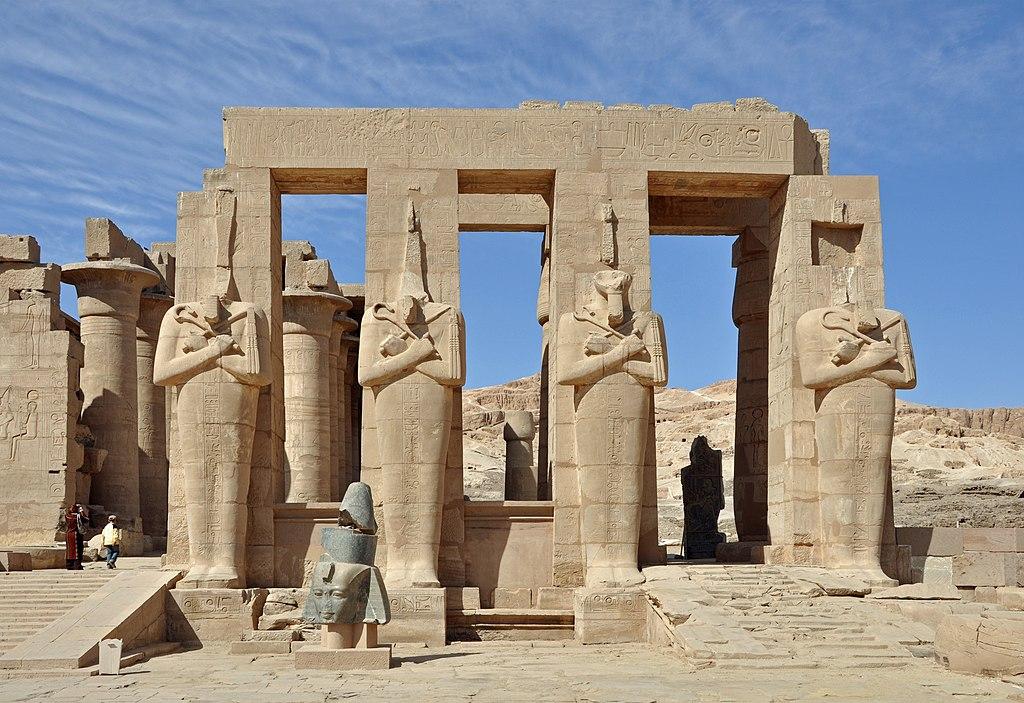
The Ramesseum Temple is a grandiose monument located in Luxor, Egypt. Built by Ramses II during the 19th Dynasty of ancient Egypt, it was designed as an homage to the great pharaoh and his accomplishments. The temple complex consists of two main structures: a large pylon gateway and a hypostyle hall...
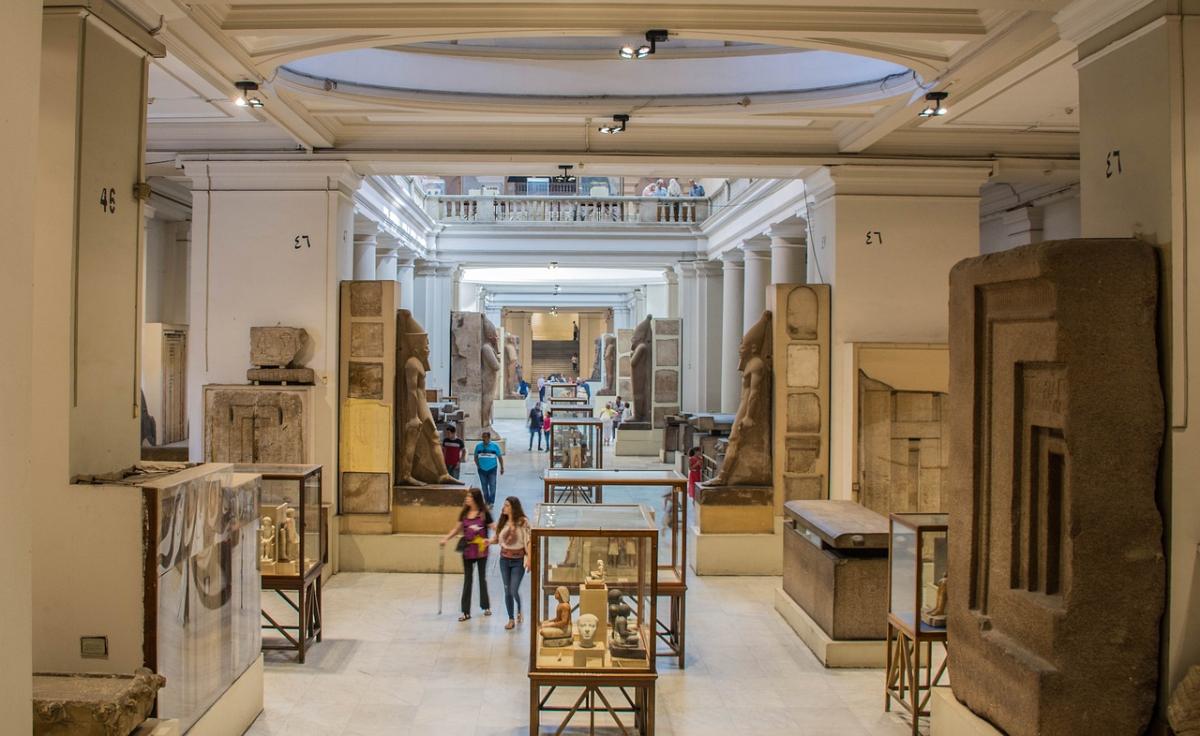
Luxor Museum is a world-famous museum located in Thebes, Egypt. Its main attraction is its Tutankhamun Collection, which consists of the artifacts found in the tomb of this ancient Egyptian pharaoh. It also houses many other artifacts from different periods of Ancient Egypt history as well as contemporary...