
Why Was Memphis the First Capital of Ancient Egypt? Discover the History of a Lost Pharaohs City
Long before Cairo became the political and cultural heart of Egypt, and centuries before Alexandria emerged as one of the Mediterranean world's greatest cities, another metropolis stood at the center of Egyptian civilization. Memphis, one of the oldest and most influential cities of the ancient world, was the place from which generations of pharaohs governed their kingdom, celebrated their gods, organized monumental construction projects, and shaped the foundations of Egyptian statehood.
Founded during the formative period of ancient Egypt, Memphis occupied an extraordinary position in the country's history. It was not simply a royal residence or administrative headquarters. It was also a major religious center, a thriving industrial settlement, and the urban heart of an enormous funerary landscape that eventually included some of the most celebrated monuments on Earth.
Today, the ancient city lies largely buried beneath the landscape surrounding Mit Rahina, south of modern Cairo. Its surviving monuments are only fragments of what was once an impressive metropolis. Nevertheless, the archaeological remains of Memphis and its surrounding necropolis provide an extraordinary window into more than three thousand years of Egyptian history.
Recognized as part of the UNESCO World Heritage property known as Memphis and its Necropolis - the Pyramid Fields from Giza to Dahshur, the ancient capital remains one of the most important archaeological landscapes in the world.
Where Was Ancient Memphis and Why Was Its Location So Important?
Ancient Memphis was situated on the western bank of the Nile, close to the point where the river valley opens into the broad agricultural landscape of the Nile Delta. Its remains are concentrated around the modern village of Mit Rahina, approximately south of Cairo.
The location was far from accidental. Memphis occupied a strategic position between Upper Egypt, which extended southward along the Nile, and Lower Egypt, the northern region encompassing the Delta.
For a ruler seeking to govern both territories, this geographical advantage was difficult to ignore. Memphis provided access to important river routes, agricultural resources, trade networks, and the principal settlements of northern and southern Egypt.
The Nile was the foundation of Egyptian civilization. It transported people, agricultural products, construction materials, and valuable commodities throughout the kingdom. A city positioned near the entrance to the Delta could therefore serve as an effective center for political administration and economic coordination.
UNESCO identifies this geographical position as one of the principal reasons for Memphis's extraordinary historical importance. Its location allowed Egyptian rulers to maintain influence over both halves of the country while benefiting from the commercial connections that passed through the region.
The surrounding landscape also offered an ideal setting for royal burial grounds. To the west of the fertile Nile Valley, the desert plateau provided elevated, relatively dry ground for monumental tombs and funerary complexes.
This relationship between the living city and the desert necropolis would become one of the defining characteristics of ancient Memphis.
The Foundation of Memphis and the Unification of Egypt
The traditional foundation of Memphis is closely associated with King Menes, the legendary ruler credited with uniting Upper and Lower Egypt around 3100 BCE.
According to later Egyptian historical traditions, Menes established Memphis as the capital of the newly unified kingdom. His decision supposedly marked the beginning of a centralized political system that would eventually produce one of the world's most enduring civilizations.
However, the historical picture is more complicated than this traditional account suggests.
Menes is not securely identified with a single archaeological figure, and scholars continue to examine the relationship between the earliest Egyptian rulers and the development of Memphis. Some historical interpretations associate Menes with early kings such as Narmer or Aha, but the evidence does not establish a definitive identification.
Archaeological research increasingly suggests that Memphis emerged through a gradual process of political consolidation and urban development rather than through one clearly documented foundation event.
The surrounding region was already becoming an important center of settlement and elite activity during the late fourth millennium BCE. The concentration of important tombs and administrative figures in the Memphite region reflects the growing importance of this area during Egypt's earliest dynasties.
Nevertheless, the traditional association between Menes and Memphis captures an important historical reality: the city became closely connected with the establishment of a unified Egyptian state.
The earliest Egyptian rulers needed more than military power to maintain control over their territories. They required an administrative center capable of organizing taxation, agricultural production, religious institutions, royal estates, and large-scale construction projects. Memphis developed into precisely this kind of political and economic hub.
What Did the Name Memphis Mean in Ancient Egypt?
The city was known by several names throughout its long history, reflecting changes in language, religion, and political traditions.
One of its earliest recorded names was Ineb-Hedj, commonly translated as the White Walls. The name may have referred to the fortified royal complex or the impressive whitewashed structures associated with the early royal settlement.
Another important name was Men-nefer, which originally referred to the pyramid complex of the Sixth Dynasty king Pepi I. Over time, the name became associated with the city itself.
The Greek form of Men-nefer eventually developed into Memphis, the name that has survived in modern historical writing.
There was also a significant religious name associated with the city: Hut-ka-Ptah, meaning the Mansion or Temple of the Ka of Ptah.
This name referred to the great religious establishment dedicated to Ptah, the principal deity of Memphis. Its importance extended far beyond local religious life.
The Egyptian name of the temple was rendered as Hikuptah in Greek. This is widely recognized as the linguistic origin of the Greek word Aigyptos, which eventually gave rise to the Latin Aegyptus and the modern English name Egypt.
It is a remarkable historical connection. The name used today for the entire country can be traced back to the religious identity of one of its oldest cities.
Memphis During the Old Kingdom: The Heart of Egyptian Power
Memphis reached exceptional political and economic importance during the Old Kingdom, conventionally dated to approximately 2686-2181 BCE.
During this period, Egypt experienced remarkable developments in centralized administration, royal architecture, religious institutions, and artistic production.
Memphis functioned as the effective administrative capital of the kingdom. Royal officials, scribes, administrators, religious authorities, and craftsmen contributed to a complex system of government that connected the pharaoh's court with settlements throughout Egypt.
The city was also an important industrial center. Ancient Egyptian manufacturing depended on highly skilled workers who produced everything from pottery and metal objects to stone vessels, furniture, religious sculptures, and architectural decorations.
Archaeological investigations have identified evidence of craft production in the Memphite region, including workshops associated with faience and stone vessel manufacturing.
The city's industrial activity was closely connected with royal and religious institutions. Temples required statues, ritual objects, furniture, and architectural components, while royal construction projects demanded enormous quantities of stonework and skilled labor.
Memphis was therefore more than a place where political decisions were made. It was a center where the practical machinery of the Egyptian state operated.
Its importance was also reflected in the monumental architecture that developed across the surrounding desert.
Memphis and the Birth of Pyramid Architecture
One of the most extraordinary aspects of Memphis's history is its relationship with the development of ancient Egyptian funerary architecture.
Although the pyramids were not constructed inside the urban center itself, the surrounding Memphite necropolis became the principal royal burial landscape of the Old Kingdom.
The necropolis extended along the western desert plateau, incorporating several major archaeological areas, including Giza, Abu Rawash, Abusir, Saqqara, and Dahshur.
These burial grounds reveal the gradual transformation of Egyptian royal tombs from relatively modest structures into some of the largest stone monuments ever constructed.
The Step Pyramid of Djoser at Saqqara
One of the most important monuments associated with the Memphite necropolis is the Step Pyramid of King Djoser at Saqqara.
Built during the Third Dynasty, around the twenty-seventh century BCE, the pyramid represents a decisive moment in architectural history. It is widely recognized as the earliest monumental stone pyramid in Egypt and one of the first major stone construction projects in human history.
The monument consists of six progressively smaller levels arranged above a massive stone structure. Its design developed from earlier mastaba tombs, which were generally rectangular structures with flat roofs and sloping sides.
The Step Pyramid was traditionally associated with the architect and royal official Imhotep, whose reputation became so extraordinary that later generations revered him as a figure of wisdom and eventually associated him with medicine and healing.
The surrounding complex was equally remarkable. It included courtyards, ceremonial structures, chapels, and architectural features designed to support the king's eternal existence.
The pyramid complex demonstrated that royal funerary architecture could become an enormous and carefully planned stone environment rather than simply a burial chamber.
Its influence extended across subsequent generations of Egyptian builders.
Dahshur and the Development of True Pyramids
Further south, the archaeological area of Dahshur preserves important evidence of the experimentation that transformed pyramid construction.
The Fourth Dynasty pharaoh Sneferu commissioned several monumental pyramids, including the famous Bent Pyramid and Red Pyramid.
The Bent Pyramid is particularly interesting because its angle changes partway up the structure. This unusual appearance is generally interpreted as evidence of adjustments made during construction.
The Red Pyramid, by contrast, represents a more successful development of the true pyramid form, with smooth external sides converging toward a single apex.
These monuments illustrate the technical experimentation that preceded the construction of the great pyramids at Giza.
The Pyramids of Giza
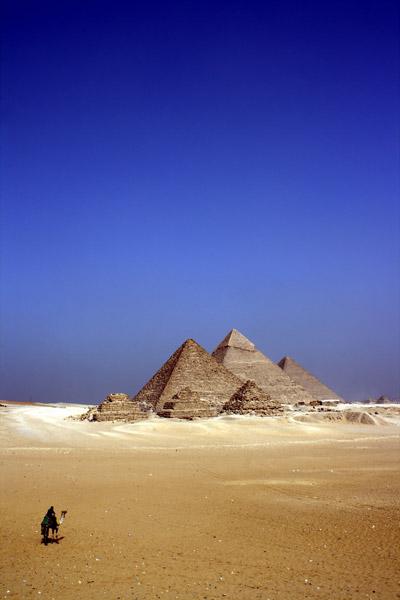
The most internationally recognized part of the Memphite funerary landscape is undoubtedly the Giza Plateau.
Here stand the three famous pyramids associated with the Fourth Dynasty pharaohs Khufu, Khafre, and Menkaure.
The Great Pyramid of Khufu is the largest of the three and the only surviving monument of the traditional Seven Wonders of the Ancient World.
Its construction required extraordinary organizational capabilities, advanced engineering knowledge, and the coordination of large numbers of skilled workers.
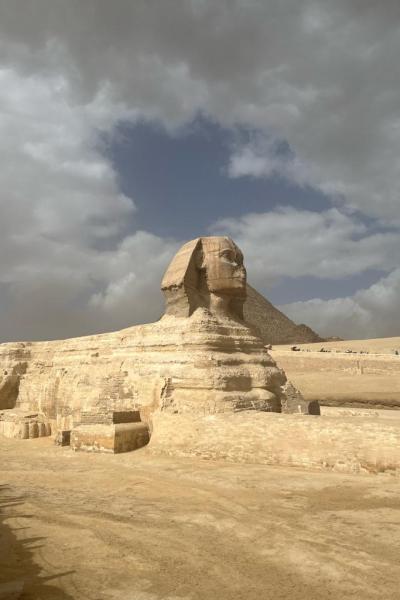
Nearby, the Great Sphinx of Giza, generally associated with the reign of Khafre, represents another extraordinary achievement of ancient Egyptian sculpture.
The Sphinx combines the body of a lion with the head of a king, creating an image that communicates royal authority, protection, and divine power.
Taken together, the pyramids of Giza, the Step Pyramid of Saqqara, and the monuments of Dahshur demonstrate the extraordinary architectural culture that developed around Memphis.
The broader UNESCO World Heritage property contains more than 38 pyramids and thousands of rock-cut tombs, illustrating the exceptional importance of this landscape to Egyptian royal and elite burial traditions.
Was Memphis Always the Capital of Ancient Egypt?
Although Memphis is frequently described as the first capital of ancient Egypt, its political position changed considerably over the centuries.
It would be misleading to imagine that the city remained the exclusive seat of government throughout the entire pharaonic period.
Egypt's political and religious centers shifted in response to dynastic changes, military developments, and the ambitions of individual rulers.
During the Middle Kingdom, the royal residence became associated with Itjtawy, a new political center established by Amenemhat I in the region of Lisht.
Thebes, in Upper Egypt, also became increasingly influential, particularly because of its religious institutions and the growing power of the god Amun.
Memphis, however, never simply disappeared from the political landscape.
During much of the New Kingdom, it continued to function as an important administrative center and royal residence, complementing the religious and ceremonial importance of Thebes.
This arrangement was particularly significant because Egypt's territory extended over a considerable distance. Maintaining important centers in both the north and south helped rulers administer the country more effectively.
Memphis During the New Kingdom
The New Kingdom, approximately 1550-1069 BCE, was one of the most powerful periods in Egyptian history.
During the early Eighteenth Dynasty, Memphis was already functioning as an important administrative center, with royal palaces and substantial religious institutions.
The city gained additional prominence under Amenhotep III, who supported royal religious projects and strengthened its monumental character.
Akhenaten, famous for his religious transformation and promotion of the Aten, also established an Aten temple in Memphis.
During the reign of Tutankhamun, the city remained an important center of government, and many high-ranking officials were buried in its surrounding necropolis at Saqqara.
Ramesses II left an especially significant architectural legacy at Memphis. Although he eventually established his principal royal residence in the eastern Delta at Pi-Ramesses, he commissioned important monuments in Memphis, including colossal statues and substantial temple structures.
His presence in the city reflected the continuing importance of its religious and political institutions.
The nearby palace of Merenptah also provides valuable archaeological evidence of royal domestic architecture during the New Kingdom.
Memphis therefore remained a major royal city even when other locations temporarily assumed greater political prominence.
Ptah: The God Who Made Memphis Sacred
To understand Memphis properly, it is necessary to look beyond its political and architectural achievements and explore its religious identity.
The city's principal deity was Ptah, a god associated with creation, craftsmanship, architecture, and artistic skill.
Ptah occupied a particularly important position in Egyptian religious thought because he represented the creative power behind the physical world and the work of skilled human hands.
Artisans, sculptors, builders, and craftsmen were closely connected with his religious sphere.
The great Temple of Ptah, known as Hut-ka-Ptah, was one of the most important religious institutions in ancient Egypt. It was a major center of worship and a place where royal ceremonies and important religious activities took place.
Unfortunately, the temple has not survived in anything approaching its original condition. Its precise original layout remains a subject of archaeological investigation, and some of its principal remains may still lie beneath the modern settlement of Mit Rahina.
Nevertheless, inscriptions, architectural fragments, and surviving sculptures demonstrate the temple's extraordinary historical significance.
The Memphite Theology and the Shabaka Stone
One of the most fascinating religious contributions associated with Memphis is the theological tradition known as the Memphite Theology.
Its most important surviving witness is the Shabaka Stone, a dark stone monument now preserved in the British Museum.
The stone was commissioned by King Shabaka of Egypt's Twenty-fifth Dynasty, around 710 BCE. Its inscription presents a creation account in which Ptah brings the world into existence through the power of thought and speech.
According to the text, the heart represents the source of thought and understanding, while the tongue gives expression to the ideas formed within it.
In this religious interpretation, creation begins as an intellectual process before becoming reality through spoken command.
The text also associates Ptah with the creation of the gods, the establishment of religious institutions, and the development of human arts and crafts.
This concept is particularly interesting because it places intellectual creativity and language at the center of the universe's creation.
The Shabaka Stone is therefore much more than a religious inscription. It provides an extraordinary insight into how ancient Egyptian thinkers understood the relationship between consciousness, language, divine authority, and the physical world.
The Sacred Apis Bull and the Serapeum of Saqqara
Another important feature of Memphis's religious life was the worship of the Apis bull.
Unlike ordinary sacred animals, the Apis bull was regarded as a divine manifestation associated with Ptah. A specially selected living bull was kept near the Temple of Ptah and treated with exceptional religious respect.
Priests identified suitable animals through distinctive physical markings. These markings were believed to reveal the bull's divine character.
The Apis bull participated in ceremonies connected with fertility, regeneration, and royal religious traditions.
Its death did not end its sacred status. Instead, the animal underwent an elaborate mummification process and received a ceremonial burial.
A new bull would subsequently be selected to continue the tradition.
The Serapeum: A Remarkable Underground Burial Complex
The burial place of the Apis bulls was the Serapeum at Saqqara, an extraordinary underground funerary complex associated with the religious traditions of Memphis.
The complex consists of long underground corridors and burial chambers that once contained enormous stone sarcophagi holding the mummified remains of the sacred bulls.
The Serapeum was in use from the reign of Amenhotep III during the New Kingdom through the Ptolemaic Period.
An avenue of sphinxes connected the religious landscape with the burial complex, emphasizing the importance of the ceremonial processions associated with the sacred animals.
The burials were not simply private religious events. They attracted royal attention and were supported by powerful religious authorities.
Two sons of Ramesses II, Khaemwaset and Merenptah, were particularly associated with the Apis cult. Both held important religious responsibilities, and inscriptions record their involvement in offerings and donations connected with the Serapeum.
Khaemwaset is especially interesting because he was also a major royal prince and High Priest of Ptah. His involvement illustrates how closely religious authority, royal power, and Memphis's political institutions were connected.
The Serapeum remains one of the most fascinating monuments in the wider Memphite archaeological landscape.
Memphis During the Late Period and the Ptolemaic Era
Memphis continued to play an important role during the Late Period, even as Egypt experienced repeated political challenges and foreign invasions.
The city retained its religious institutions, administrative significance, and connections with the royal tradition.
The surviving remains of the Palace of Apries, associated with the Twenty-sixth Dynasty, provide evidence of Memphis's continuing importance as a political and royal center.
The arrival of Alexander the Great in 332 BCE introduced another major transformation.
After conquering Egypt, Alexander established Alexandria on the Mediterranean coast. Following his death, the Ptolemaic dynasty developed the new city into the principal political, commercial, and cultural capital of the country.
Memphis consequently lost its former position as the dominant political center.
However, it remained far from insignificant.
During the Ptolemaic Period, Memphis was generally regarded as the second most important city in Egypt after Alexandria. Its High Priests of Ptah maintained considerable influence among Egyptian religious institutions and enjoyed important relationships with the ruling dynasty.
The city's traditional religious practices also continued to flourish.
Saqqara remained an important center for the worship and burial of sacred animals, particularly the Apis bull.
This period illustrates how an ancient city could lose its political supremacy while retaining substantial religious, cultural, and economic influence.
Why Did Memphis Decline and Eventually Disappear?
The decline of Memphis was not the result of a single historical event. It developed gradually through several political, administrative, religious, and economic changes.
The establishment of Alexandria reduced Memphis's importance as the principal center of government and international commerce. Under Roman rule, further changes in administrative organization weakened the city's traditional position.
Nevertheless, Memphis remained an important religious settlement for centuries.
The worship of Ptah and the Apis bull continued into the Roman period, although the surviving evidence suggests that traditional religious institutions gradually lost their influence.
The decline of the city's ancient religious landscape became particularly apparent during the third and fourth centuries CE.
Another major factor in the disappearance of Memphis's monumental architecture was the widespread reuse of ancient building materials.
Stone was an extremely valuable resource in Egypt. The enormous quantities of limestone and granite used in temples, palaces, and monuments represented considerable economic value to later builders.
As Memphis lost its political and religious prominence, many of its abandoned structures became sources of construction material.
Architectural blocks from ancient monuments were dismantled, transported, and incorporated into later buildings. Some limestone was also burned to produce lime.
Similar practices affected other ancient Egyptian cities, but they had a particularly significant impact on Memphis because of its proximity to later population centers.
The establishment of Fustat following the Arab conquest of Egypt in the seventh century further shifted the region's urban and administrative focus.
Fustat eventually developed alongside the growing settlement of Cairo, which became the dominant political center of Egypt.
Memphis gradually lost its identity as a major urban settlement. Its monumental buildings disappeared, its ancient urban landscape became increasingly difficult to recognize, and much of its history survived through inscriptions, scattered archaeological remains, and historical accounts.
What Can Visitors See at Memphis Today?
Although ancient Memphis no longer exists as a complete city, visitors can still explore some of its surviving monuments at Mit Rahina, where an archaeological museum and outdoor displays preserve important remains from the ancient capital.
One of the most impressive surviving monuments is the colossal limestone statue of Ramesses II.
The enormous statue was discovered in the area of Memphis and is displayed horizontally inside a protective museum structure. Its remarkable craftsmanship allows visitors to appreciate the scale and artistic sophistication of royal sculpture during the Nineteenth Dynasty.
The statue's facial features, royal insignia, and carefully carved details provide a tangible connection with one of Egypt's most celebrated pharaohs.
The museum also preserves numerous architectural fragments, statues, inscriptions, and other objects recovered from the archaeological landscape.
Another important aspect of the visit is the opportunity to understand the relationship between Memphis and the surrounding pyramid fields.
Saqqara, located within the wider Memphite necropolis, is particularly significant because it contains the Step Pyramid of Djoser, numerous royal and private tombs, and the Serapeum.
Giza and Dahshur also form essential parts of this wider historical landscape.
It is important to remember that these are separate archaeological areas within the larger UNESCO property, rather than monuments located within the ancient urban center itself.
For visitors interested in ancient Egyptian history, exploring Memphis together with Saqqara offers a much richer understanding of the region than visiting either location independently.
It reveals how the ancient Egyptians organized their political centers, royal burial grounds, temples, and ceremonial landscapes into an interconnected cultural environment.
The Archaeological Rediscovery of a Lost Capital
The modern archaeological investigation of Memphis has taken place over more than two centuries.
Napoleon's expedition to Egypt in 1798-1801 helped bring the ancient site back into wider European scholarly attention. Subsequent researchers and archaeologists gradually began documenting its surviving monuments and reconstructing aspects of its historical geography.
Among the important early investigators was the British archaeologist Flinders Petrie, whose excavations and surveys contributed significantly to the understanding of Memphis and its surrounding archaeological sites.
More recent research has continued to reveal how extensive the ancient settlement was.
Ancient Egypt Research Associates (AERA), working with Egyptian archaeological authorities and other research institutions, has conducted archaeological documentation, field training, and heritage projects in the Memphis area.
These investigations have helped identify residential districts, cemeteries, temple remains, and other archaeological features that contribute to a more detailed understanding of the ancient city.
One of the greatest challenges is that the original urban landscape is difficult to reconstruct.
Changes in the course of the Nile affected the city's geographical setting, and the location of the settlement shifted over time. In addition, many ancient buildings were dismantled or buried beneath later deposits and modern development.
Even the exact position and original layout of the great Temple of Ptah remain subjects of archaeological investigation.
This means that Memphis is not simply a site where archaeologists uncover isolated monuments. It is an enormous historical landscape whose full extent and development are still being investigated.
Why Memphis Remains One of the Most Important Cities in Ancient Egyptian History
The historical importance of Memphis extends far beyond its reputation as Egypt's first capital.
It was one of the principal places where the political, religious, economic, and artistic traditions of ancient Egyptian civilization developed together.
Its strategic location helped rulers maintain authority over Upper and Lower Egypt. Its administrative institutions supported a centralized state. Its workshops contributed to the production of objects and monuments that defined Egyptian material culture.
The surrounding necropolis preserves evidence of one of humanity's greatest architectural achievements: the transformation of royal tombs into monumental pyramids.
Its religious institutions also contributed important ideas to Egyptian theology, particularly through the worship of Ptah and the traditions preserved in the Shabaka Stone.
Even after Alexandria became the country's dominant capital, Memphis continued to exert influence through its temples, priesthoods, and ancient ceremonies.
Today, the surviving monuments may appear modest compared with the enormous pyramids of Giza or the monumental temples of Luxor and Karnak. Yet their historical significance is extraordinary.
Memphis represents the moment when the Egyptian state began to take a recognizable institutional form. It connects the earliest dynasties with the Old Kingdom pyramid builders, the powerful pharaohs of the New Kingdom, the religious traditions of the Late Period, and the cultural transformations of the Greco-Roman world.
To explore Memphis is to look beyond individual pyramids and famous kings and discover the foundations of a civilization that shaped human history for thousands of years.
Its buildings may have largely disappeared, but the influence of this remarkable ancient capital remains deeply embedded in the history of Egypt.

Egypt is a destination where ancient history, extraordinary landscapes, and everyday life come together in ways few other countries can match. One moment, you might be standing beneath the towering columns of an ancient temple; the next, you could be sailing along the Nile, wandering through the lively...

Egypt is a destination where history, spirituality, culture, and natural beauty come together in remarkable ways. From the centuries-old mosques of Cairo to the peaceful banks of the Nile, the ancient wonders of Luxor, and the turquoise waters of the Red Sea, the country offers an extraordinary variety...

Egypts extraordinary historical heritage extends far beyond its pyramids, pharaonic temples, and royal tombs. Scattered throughout the country, from the narrow passageways of Old Cairo to the remote deserts surrounding the Red Sea, ancient Coptic churches preserve another remarkable chapter of Egyptian...