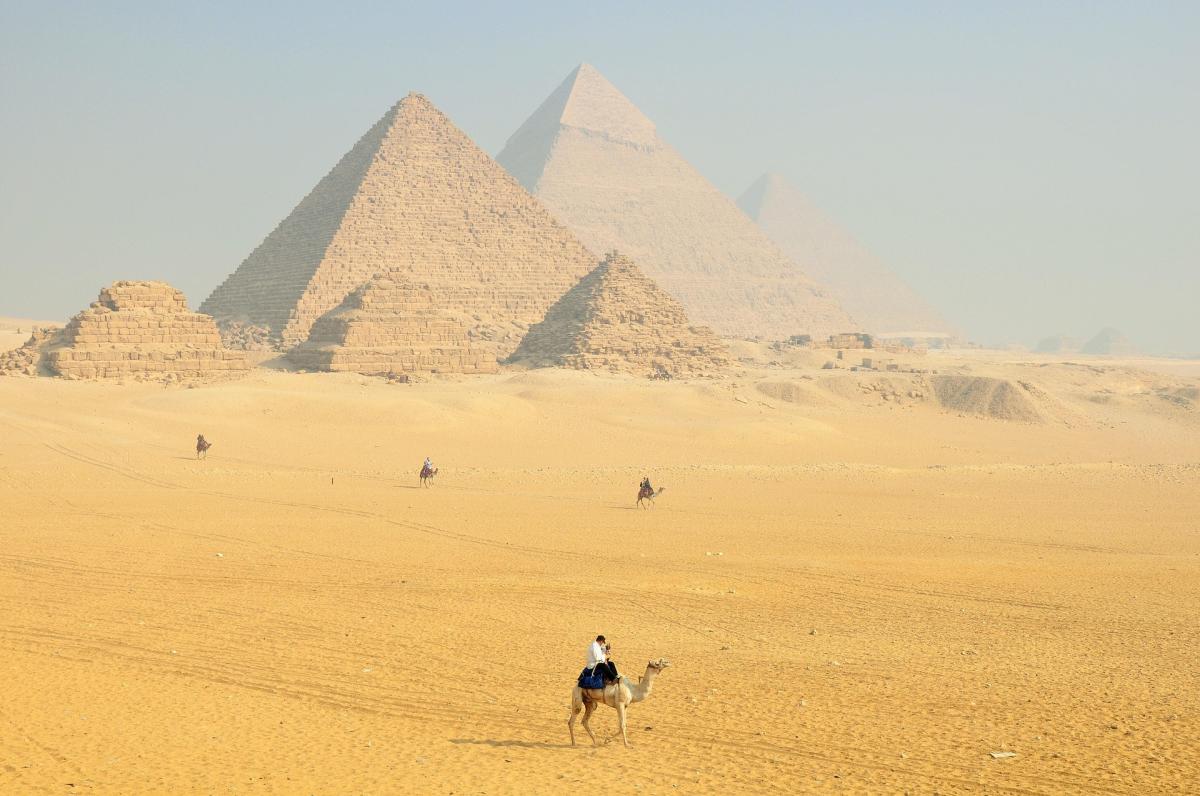
A Closer Look at the Extraordinary Giza Pyramids
The Giza pyramid complex, a testament to human ingenuity and ambition, stands on the Giza Plateau at the edge of the Western Desert, approximately 13 km (8.1 mi) southwest of Cairo's city center. These monumental structures, the last remaining of the Seven Wonders of the Ancient World, have captivated humanity for millennia. This report delves into the history, construction, purpose, and enduring mysteries of these extraordinary pyramids, the temples that served them, the tombs of the elite who built them, and the enigmatic Sphinx that guards them.
The Giza Necropolis: A City of the Dead
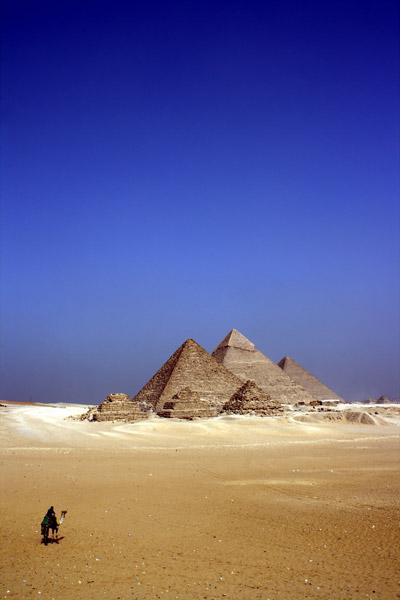
The Giza Plateau is a vast necropolis that served as the final resting place for the pharaohs of the 4th Dynasty of the Old Kingdom (c. 2600-2500 BC). The complex is dominated by three main pyramids built for three successive generations of rulers: Khufu, his son Khafre, and his grandson Menkaure. Each pyramid was the centerpiece of a larger mortuary complex designed to ensure the pharaoh's successful journey to the afterlife and sustain his cult for eternity.
A complete royal pyramid complex typically included:
- A main pyramid for the pharaoh's burial.
- Smaller subsidiary pyramids for queens and a satellite pyramid for the king's symbolic use.
- A mortuary temple at the base of the pyramid for the daily offering cult of the deceased king.
- A valley temple near the Nile, where the pharaoh's body was received and prepared for burial.
- A causeway connecting the valley and mortuary temples, serving as a sacred processional route.
- Mastaba tombs for nobility and royal family members, laid out in vast cemeteries.
- Pits containing buried solar boats, intended for the pharaoh's use in the afterlife.
The Tombs of the Elite: Mastabas of the Eastern and Western Cemeteries
The areas surrounding the Great Pyramid contain extensive cemeteries that housed the tombs of the royal family and the highest-ranking officials of the 4th Dynasty. These tombs, known as mastabas, were rectangular, flat-roofed structures with sloping sides, whose name derives from the Arabic word for "bench".
- Social Hierarchy in Stone: The layout of these cemeteries provides a clear map of the 4th Dynasty's social hierarchy. The size, complexity, and proximity of a mastaba to the king's pyramid were direct indicators of the owner's status. The Eastern Cemetery was reserved for Khufu's closest relatives, who were interred in massive double mastabas. The Western Cemetery, meticulously arranged in a grid-like pattern of streets, was for high-ranking officials like Hemiunu, the vizier who oversaw the Great Pyramid's construction. This organization shows the elite vying for a position near the king in the afterlife, likely in exchange for their support of his monumental building projects.
- Architecture of the Mastaba: A typical mastaba consisted of an above-ground superstructure for public memorial and a subterranean burial chamber reached by a deep shaft, which was sealed with rubble to deter robbers. The superstructure, conceived as a "house for eternity," contained an offering chapel with a "false door"-a symbolic portal through which the deceased's spirit, or ka, could receive offerings. Some tombs also included a serdab, a sealed chamber containing a statue of the deceased that served as a substitute body for the ka.
- Reliefs and Daily Life: Unlike the stark, undecorated interiors of the 4th Dynasty pyramids, the chapels of these private tombs were often richly adorned with painted reliefs. These scenes are an invaluable source of information, depicting agricultural work, boat building, hunting, and the presentation of offerings, all intended to magically provide for the deceased in the afterlife. The reliefs in the tomb of Queen Meresankh III, for example, show vibrant scenes of royal life.
- Significant Artifacts: Discoveries from the mastabas illuminate the beliefs and status of their owners. Inscriptions list titles like "Vizier" and "Overseer of all Royal Works," detailing the administrative hierarchy. Other finds include the so-called "reserve heads"-realistic limestone sculptures of the deceased-and finely crafted statues like the painted bust of Prince Ankhhaf. These statues were considered physical vessels for the ka to inhabit.
Subsidiary and Satellite Pyramids
The main pyramid complexes also included smaller pyramids with distinct purposes.
- Subsidiary Queens' Pyramids: These smaller pyramids, typically located to the east or south of the main pyramid, were the tombs for the king's wives and mothers. They were essentially miniature pyramid complexes, often featuring their own small mortuary temple for the queen's funerary cult. Khufu's complex has three such pyramids to its east, while Menkaure's has three to its south. The identity of their occupants is sometimes debated; for instance, pyramid GI-a near Khufu's has been attributed to either his mother, Hetepheres I, or his wife, Queen Meritites I.
- Satellite Pyramids: Each main complex also included a single, even smaller "satellite pyramid," whose purpose is enigmatic and highly debated. These were not burial places for queens. The leading theories suggest they were used for rituals, possibly as a changing room for the king during the sed-festival (a jubilee to rejuvenate his power), or as a symbolic tomb for the king's ka. Other ideas propose they were for a canopic burial (the king's viscera) or for storing royal regalia. The substructure of Khufu's satellite pyramid (G1-d) contained no sarcophagus, adding to the mystery.
The Great Pyramid of Giza: A Feat of Engineering
Built for Pharaoh Khufu (reigned c. 2589-2566 BC), the Great Pyramid is the oldest and largest of the three. For over 3,800 years, it stood as the tallest man-made structure in the world.
Key Facts about the Great Pyramid:
- Original Height: 146.6 meters (481 feet). Its current height is around 138.5 meters (454 feet) due to erosion.
- Base: Approximately 230.3 meters (756 feet) on each side.
- Construction: It is composed of an estimated 2.3 million stone blocks, with an average weight of 2.5 tons each, for a total mass of about 6 million tonnes. The core was made of local limestone, while the now-missing outer casing was of fine white Tura limestone. The interior chambers used massive granite blocks from Aswan, some weighing up to 80 tonnes.
- Precision: The pyramid is a masterpiece of precision, aligned with extraordinary accuracy to the four cardinal points.
Inside the Great Pyramid:The interior of the Great Pyramid is stark and undecorated, unlike the lavishly decorated mastaba tombs of the same period. It contains a network of chambers and passages:
- The King's Chamber: Located high within the pyramid, this chamber is lined with granite and contains Khufu's sarcophagus.
- The Queen's Chamber: A misnomer, this chamber is situated below the King's Chamber; its purpose is still debated.
- The Grand Gallery: A magnificent corbelled passageway that ascends to the King's Chamber.
- Subterranean Chamber: An unfinished chamber carved into the bedrock beneath the pyramid.
- Mysterious Shafts: Narrow shafts extend from the King's and Queen's Chambers. Some researchers suggest they are "star shafts" pointing towards specific constellations, such as Orion's Belt, a key component of the Orion Correlation Theory.
The Pyramid of Khafre and the Great Sphinx
Pharaoh Khafre, Khufu's son, built the second-largest pyramid at Giza. Although slightly smaller than the Great Pyramid, it appears taller because it was built on a higher section of the plateau. It is the only one of the three main pyramids to retain some of its original polished limestone casing at its apex.
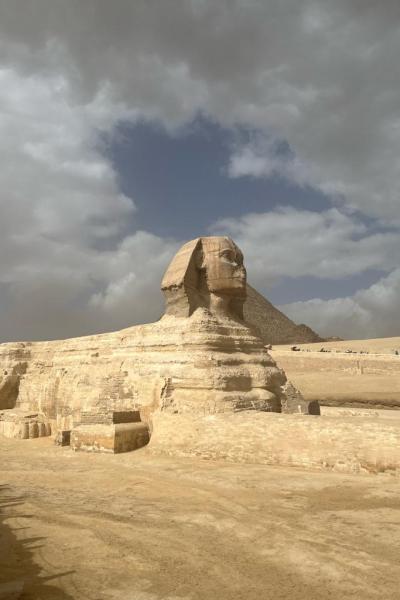
The Great Sphinx:Believed to have been built during Khafre's reign, the Great Sphinx is a colossal statue guarding the pyramid complex. It has the body of a lion and the head of a human, thought to be a representation of Khafre himself. The Sphinx was not assembled but carved from a single massive outcrop of limestone bedrock, measuring approximately 73 meters (240 feet) long and 20 meters (66 feet) high.
Khafre's Mortuary and Valley Temples
Khafre's complex is one of the best-preserved from the Old Kingdom and provides significant insight into the function of these sacred spaces.
- Architectural Features: Both temples were constructed with enormous limestone core blocks (some over 100 tons) and faced with polished red granite from Aswan. The well-preserved Valley Temple features a T-shaped hall with 16 massive granite pillars, an alabaster floor, and an innovative lighting system using narrow slits in the roof. The Mortuary Temple was even more elaborate and once housed over 50 life-size statues of the pharaoh.
- Ritual Functions: The Valley Temple was the ceremonial gateway where the pharaoh's body was received for purification and mummification. It was here that the crucial "Opening of the Mouth" ceremony was performed to magically restore the deceased's senses. A procession then carried the body up the 494.6-meter-long causeway to the Mortuary Temple for the daily offering cult.
- Significant Archaeological Discoveries: In 1860, Auguste Mariette discovered the magnificent diorite statue of a seated Khafre in the Valley Temple. This iconic piece depicts the falcon god Horus protecting the king's head, symbolizing divine kingship. The temple may have originally held as many as 23 such statues.
The Pyramid of Menkaure
The southernmost and smallest of the three main pyramids was built for Pharaoh Menkaure, Khafre's son. Though smaller, its associated temples have yielded a wealth of high-quality statues.
Menkaure's Mortuary and Valley Temples
Menkaure's complex tells a story of ambitious plans altered by the king's premature death.
- Architectural Features: The temples were begun with massive limestone foundations and granite facing, with one block in the mortuary temple weighing an estimated 220 tons. However, the king died before their completion, and his successor, Shepseskaf, hastily finished the structures in crude mudbrick. An inscription states that Shepseskaf "made it (the temple) as his monument for his father".
- Ritual Functions: The temples served the funerary cult of Menkaure, where priests performed daily rituals. Because the mudbrick walls could not be decorated with reliefs, the cult focused on statues, which were considered physical vessels through which the deceased could live and receive offerings. The ancient Egyptian word for sculptor was "he who causes to live".
- Significant Archaeological Discoveries: Between 1908 and 1910, an expedition led by George Reisner discovered some of the most famous examples of Old Kingdom art in the Valley Temple. These include the magnificent triad statues depicting Menkaure with the goddess Hathor and various deities, as well as the renowned dyad statue of the king and a queen. Menkaure's basalt sarcophagus was lost at sea during transport to Great Britain.
Construction: Engineering an Empire
The construction of the pyramids was a massive logistical feat accomplished not by slaves, but by a well-organized and state-supported community of paid laborers. Excavations at the workers' village reveal a purpose-built urban center with bakeries, workshops, and evidence of a well-fed workforce that received advanced medical care.
Quarrying Methods
The Egyptians sourced materials from various locations using different techniques.
- Limestone: The bulk of the core blocks were quarried directly from the Giza plateau. The fine, white limestone for the outer casing came from high-quality quarries at Tura, across the Nile, where it was mined in deep underground tunnels. Workers used copper or bronze chisels and picks to cut trenches around the softer limestone blocks before using levers to break them free.
- Granite: For the hard, red granite used in burial chambers and sarcophagi, workers traveled hundreds of miles south to Aswan. Here, they pounded the rock with dolerite balls, which are even harder than granite, to create channels. Other methods included inserting wooden wedges into grooves and soaking them with water, causing the expanding wood to split the rock, and possibly fire-setting (heating the rock then dousing it with water to crack it).
Transportation Techniques
Moving the immense blocks was a monumental challenge solved with remarkable ingenuity.
- Water Transport: The Nile River was the primary highway for moving stone. Recent research has confirmed the existence of a now-extinct branch of the Nile, the "Ahramat" or "Khufu" branch, that flowed much closer to the Giza plateau and terminated in an artificial harbor. Large wooden barges floated the heavy granite from Aswan and fine limestone from Tura to this harbor, especially during the annual Nile flood.
- Land Transport: Once on land, blocks were loaded onto massive wooden sledges and pulled by teams of men. A famous tomb depiction shows a person pouring water on the sand in front of the sledge; experiments have shown that wetting sand to the right consistency reduces friction by up to 50%, making it far easier to drag the multi-ton loads. For steep inclines, a ramp system discovered at Hatnub, flanked by staircases and postholes, suggests ropes were wound around posts for mechanical advantage to haul blocks up slopes of 20% or more.
Purpose, Beliefs, and Celestial Alignments
The pyramids were fundamentally tombs, built as "houses of the dead" to protect the pharaoh's body and serve as a vessel for his soul, or "Ka," to ascend to the heavens. The shape itself may have symbolized the primordial mound of creation or the rays of the sun god, Ra.
The Riddle of Cardinal Point Alignment
The pyramids exhibit an extraordinary alignment with the four cardinal points. The Great Pyramid's alignment is remarkably precise, with only a minuscule deviation. While no engineering documents have been found, several compelling theories explain this precision :
- The Solar Method (Equinox): A prevalent theory suggests engineers tracked the shadow of a vertical pole (a gnomon) on the fall equinox to determine a perfect east-west line.
- The Stellar Method (Circumpolar Stars): Another hypothesis posits that astronomers used pairs of circumpolar stars like Kochab and Mizar or Phecda and Megrez to establish a true north-south line.
The Orion Correlation Theory: A Celestial Controversy
Popularized by Robert Bauval, this theory proposes that the layout of the three Giza pyramids was intentionally designed to mirror the three stars of Orion's Belt, a constellation the Egyptians associated with the god Osiris. However, the theory is largely rejected by mainstream Egyptologists due to a lack of textual evidence, inaccuracies in the star map (the map of Giza must be inverted to match), and archaeological evidence suggesting sequential, not pre-planned, construction.
Recent Discoveries: Peering into the Void
Modern technology continues to unveil new secrets. The ScanPyramids project, using non-invasive particle physics, has made remarkable discoveries inside the Great Pyramid.
The Science of Muon Tomography
Cosmic-ray muon tomography is an imaging technique that uses naturally occurring subatomic particles called muons. Muons are created when cosmic rays from space hit Earth's atmosphere and can penetrate hundreds of meters of stone. By placing detectors around a structure, scientists can track the number of muons passing through it. Voids or less dense areas allow more muons to pass through than solid rock, enabling the creation of a 3D map of the structure's internal density and revealing hidden chambers without any physical intrusion.
The 'Big Void' (ScanPyramids Big Void)
In 2017, the ScanPyramids team announced the discovery of a massive void above the Grand Gallery, detected by three separate muon technologies.
- Characteristics: The void is estimated to be at least 30 to 40 meters (98 to 131 feet) long. Its cross-section is large, possibly similar to the Grand Gallery's, though some data suggests it may be squarer (approx. 4x4 meters).
- Hypotheses: Its purpose is unknown. The leading theory is that it is a large weight-relieving chamber to reduce stress on the Grand Gallery's ceiling, analogous to the chambers above the King's Chamber. Other theories suggest it could be part of an internal construction ramp or, more speculatively, a hidden chamber.
The Hidden Entrance Corridor (ScanPyramids North-Face Corridor)
The project also detected a corridor behind the chevron-shaped blocks on the pyramid's north face.
- Characteristics: This horizontal corridor is approximately 9 meters (30 feet) long with a 2x2 meter cross-section. In 2023, an endoscopic camera confirmed its existence, revealing an empty corridor with a gabled or "saddle vault" ceiling.
- Hypotheses: The prevailing theory is that it is another weight-relieving feature, designed to protect the descending passage below it. However, some researchers question if such a large structure was needed for this purpose and speculate it may have had another function.
Summary
The Pyramids of Giza, located on the outskirts of modern Cairo, are an enduring symbol of ancient Egypt's power, architectural prowess, and profound religious beliefs. Built during the 4th Dynasty as elaborate tombs for the pharaohs Khufu, Khafre, and Menkaure, the complex was a masterpiece of engineering and social organization. The Great Pyramid of Khufu, the largest of the three, stood as the world's tallest structure for nearly four millennia and exhibits a near-perfect alignment with the cardinal points, a feat likely achieved through sophisticated solar or stellar observation methods.
The Giza necropolis was a meticulously planned "city of the dead." Surrounding the royal pyramids are vast cemeteries of mastaba tombs for the kingdom's elite, with their location and size reflecting a rigid social hierarchy. The decorated chapels of these tombs provide a vibrant window into the daily life, economy, and administration of the era. The construction of these monuments was a massive state project accomplished by a skilled, paid workforce. They employed ingenious quarrying techniques for both local limestone and granite brought from Aswan, hundreds of miles away. Transport was achieved via a now-extinct branch of the Nile that brought barges to a harbor at the foot of the plateau and by using sledges over land, made easier by wetting the sand to reduce friction.
Each pyramid was part of a larger complex including a valley temple for purification rituals like the "Opening of the Mouth" ceremony, and a mortuary temple for the king's eternal cult. The complex also includes the enigmatic Great Sphinx, subsidiary pyramids for queens, and mysterious satellite pyramids whose purpose is still debated. In recent years, the ScanPyramids project, using cosmic-ray muon tomography, has revolutionized our understanding of the Great Pyramid's internal structure. It has revealed a massive "Big Void" above the Grand Gallery and a hidden corridor near the main entrance, both believed to be structural or construction-related features, adding new layers of mystery to these ancient wonders.
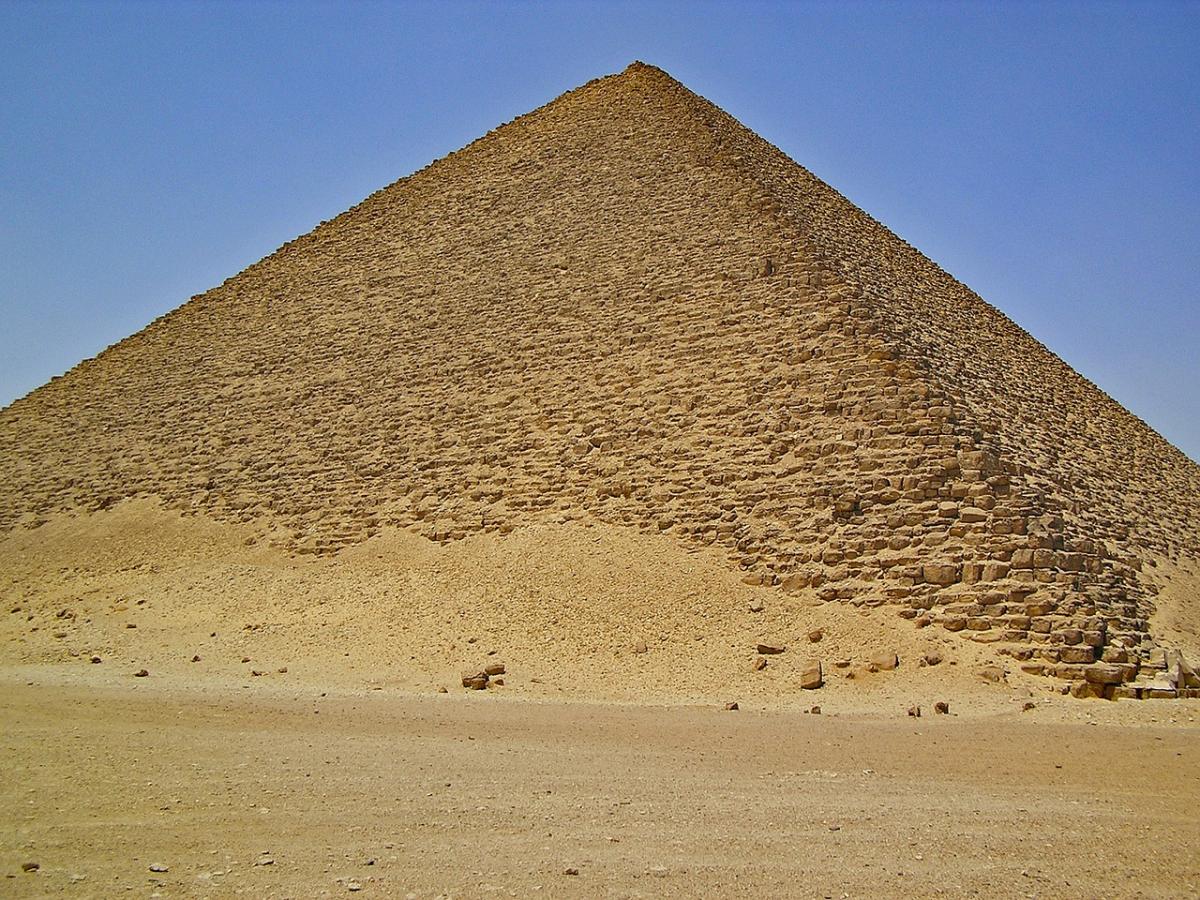
Nestled in the desert on the west bank of the Nile River, approximately 40 kilometers south of Cairo, lies the ancient royal necropolis of Dahshur. This significant archaeological site, part of the larger Memphis necropolis and a UNESCO World Heritage Site, is a testament to the architectural ingenuity...
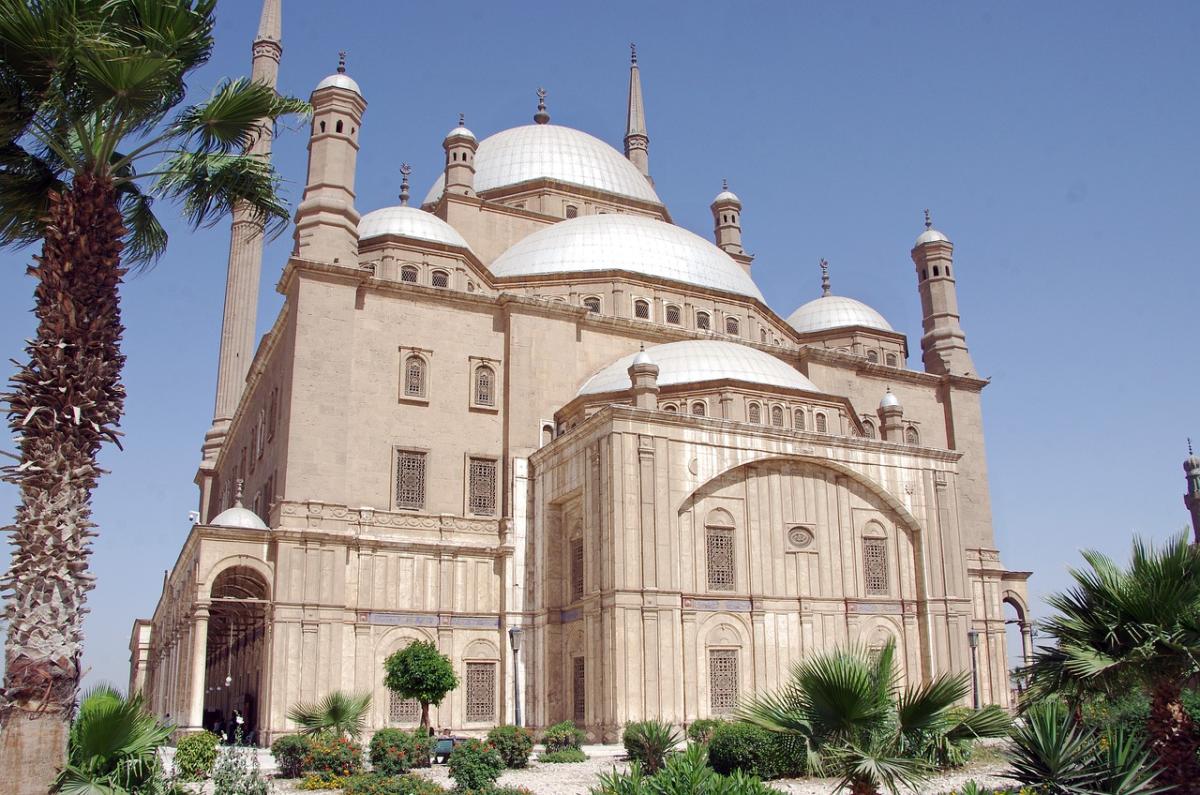
The Citadel of Cairo, also known as the Citadel of Saladin, is a medieval Islamic-era fortification that stands as a testament to Egypts rich and layered history. Perched atop the Mokattam hills near the center of Cairo, it offers a strategic and commanding view of the city. For nearly 700 years, from...
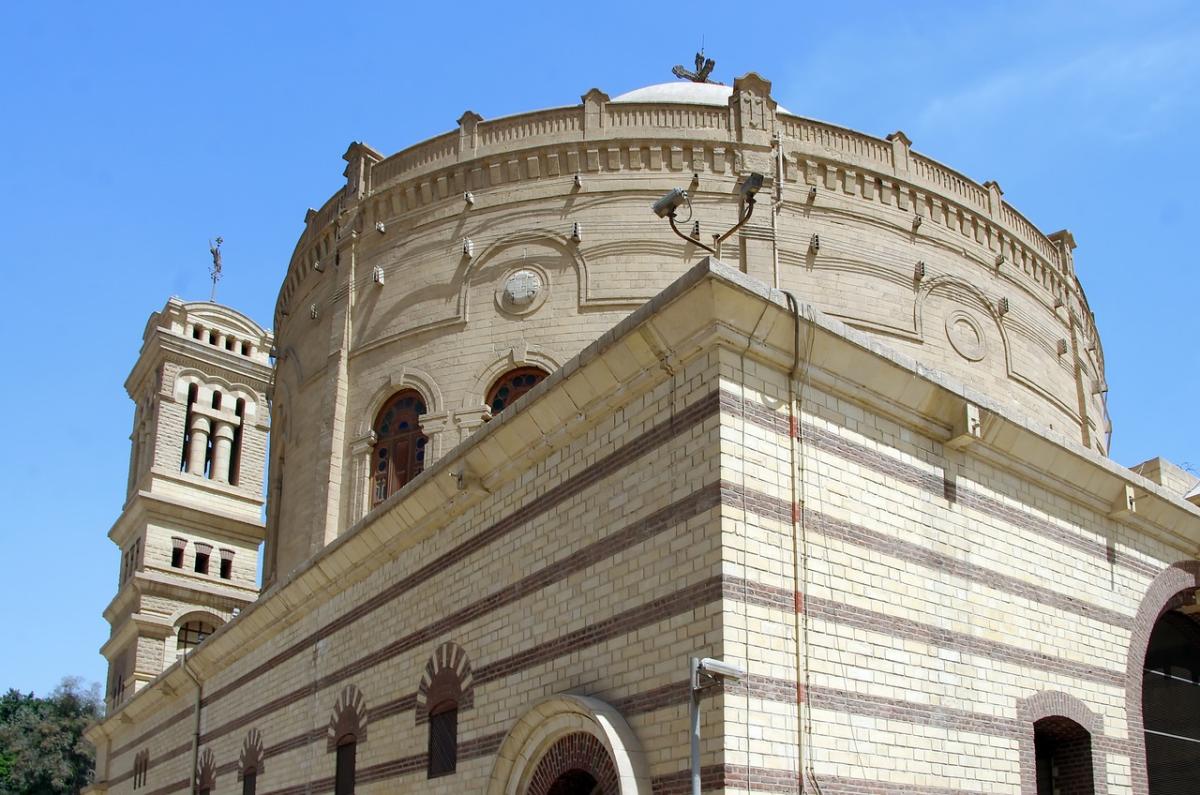
Coptic Cairo, a historic district nestled within Old Cairo, stands as a testament to Egypts rich and enduring Christian heritage. This ancient enclave, a place where Pharaonic, Greco-Roman, and Islamic cultures have intertwined, offers a profound glimpse into the spiritual and cultural legacy of one...